A canal craze swept the nation after the Erie Canal was completed in 1825, resulting in many states looking to create canal systems. Indiana began planning a man-made waterway to connect Lake Erie in Toledo, Ohio, to the Ohio River in Evansville as early as 1826. The United States Congress gave Indiana a large amount of land to begin canal construction the following year. Construction on the Wabash and Erie Canal finally began with a groundbreaking ceremony in Fort Wayne on February 22, 1832. Advertisements for available construction jobs in Indiana were a major draw for Irish immigrants coming to the United States in the 1830s and 1840s. By 1837, about one thousand workers were employed on canal projects throughout the state. Newspapers circulated advertisements to recruit more workers. Though not explicitly recruiting Irish workers, advertisements appealed to immigrants who needed a well-paying job.
Arriving at the canal corridor, Irish men found jobs as contractors and laborers. Some advertisements in news publications around the state promised laborers lodging and $20 a month for their work and offered plots of land around the canal for $1.25 per acre. However, most laborers only received $10 a month, roughly worth about $363 today. Contractors often docked workers’ pay to account for food and lodging costs. Sometimes, the canal company paid laborers in certificates for small pieces of land rather than money.
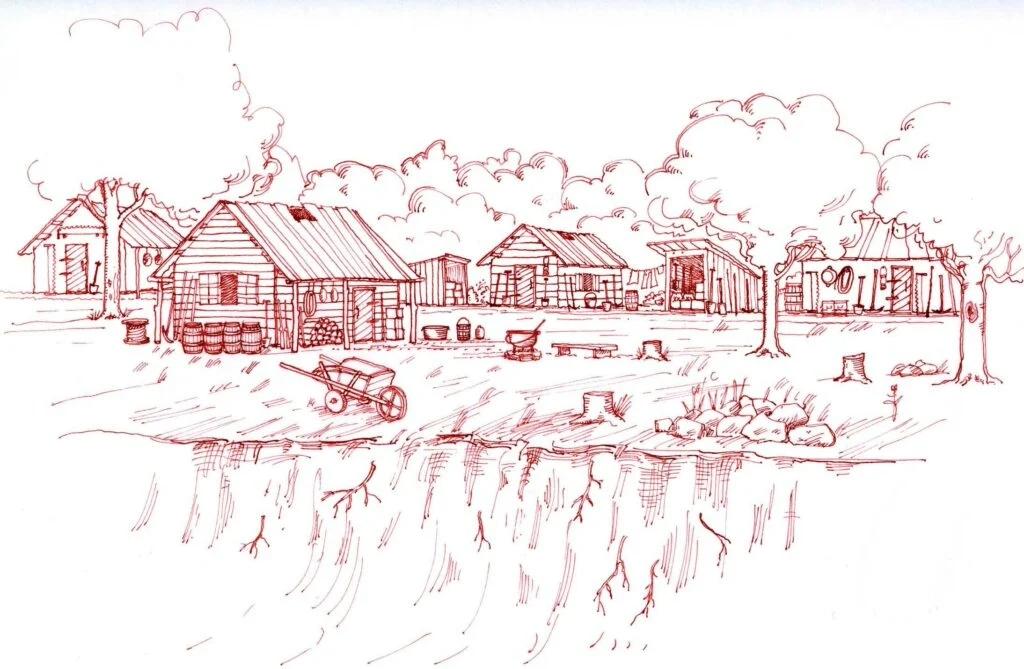
Canal workers faced many hardships. Irish immigrants working on the canal lived in small, unhealthy shelters. The men, some with their wives and children, usually lived in cheaply built camps of 100-200 people. Contractors often had small homes to themselves, while most laborers lived together in larger buildings. Diseases were common in the canal environment, especially among the camps. Insects carrying illnesses, poor sanitation practices, and hard labor resulted in a high death rate among canal hands. The work itself was brutal. Men first cleared wide paths through trees and brush. Diggers followed, using picks and shovels to load cleared earth into horse-drawn carts. Many camps had nearby mass graves to bury laborers who died in work accidents and malaria or cholera outbreaks.
Thousands of Irish laborers survived horrible conditions and backbreaking work to complete the Wabash and Erie Canal in 1843. At 468 miles, the canal was the longest in the United States. Navigable water systems were important to the transportation of both goods and people. Indiana became more involved in national trade routes with the canal connecting the state to the Great Lakes via Toledo. However, the state did not have enough money to maintain the canal for long. The Wabash and Erie Canal closed in the 1870s.
Images