Filed Under Story

Office of Helene Knabe, M.D.
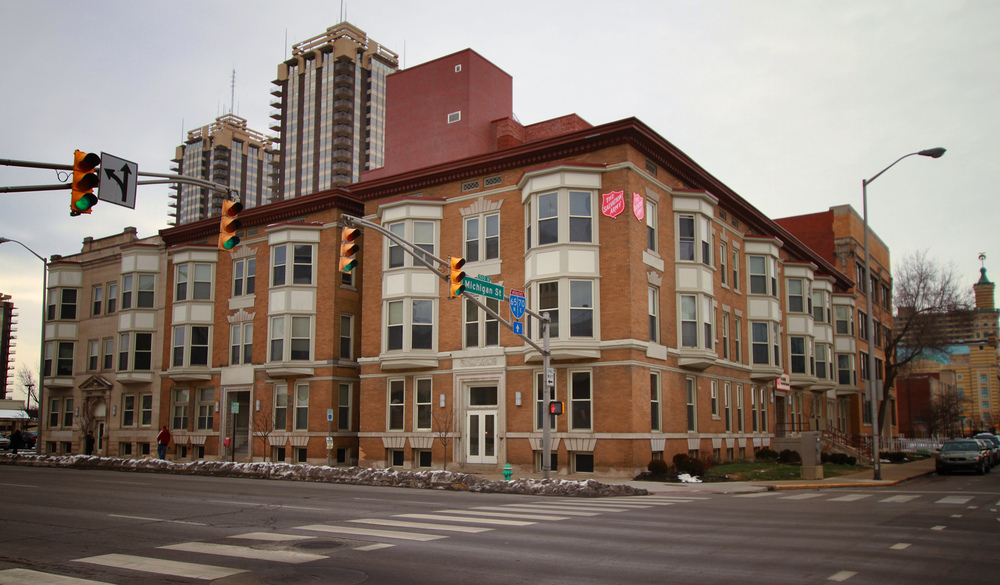
The "Delaware Flats," the building farthest to the right (south) at the corner of North Delaware and East Michigan Streets, was the location of the combination office-apartment home of Helene Knabe, M.D. She was a bacteriologist whose significant contributions to Indiana public health are often overshadowed by her sensationalized murder at age 35 in this building on the night of October 24-25, 1911.

Background and Education, 1875-1904

Born in 1875 in Germany to a family of modest means, Helene Elise Hermine Knabe earned money to emigrate to the U.S., where women could study medicine. She arrived in New York on November 16, 1896, and in Indianapolis two days later, lodging at a boarding house where her cousin, Auguste Knabe, also boarded. She took a course at Butler College in the summer of 1900 and then entered the Medical College of Indiana (MCI), apparently also working as a nurse during this period. MCI held its neurology and psychiatry classes in the Pathology Building at Central State Hospital, so Knabe likely attended classes in what is now the Medical History Museum (also on this tour). She graduated as a physician on April 23, 1904, with three years' specialized experience assisting a faculty member with postmortem examinations and microscopic analysis.

State Laboratory of Hygiene and Rabies Expert, 1905-1908

Beginning in 1905, Dr. Knabe worked for the State Board of Health's Laboratory of Hygiene as a Deputy State Health Officer, investigating cases of poor sanitation, typhoid (about which she would later publish a professional paper), and other diseases. She rose quickly to Assistant Pathologist and, in 1906, to Assistant State Bacteriologist.

After completing specialized study with renowned experts on rabies, she became the first in Indiana to use the innovation of dissecting heads of animals suspected to be infected, and to recommend the Pasteur method: during the incubation period, people exposed to rabies received increasingly strong inoculations containing the diluted virus, thereby stimulating antibody production and greatly reducing the chances of developing the disease. By 1912, this treatment had reduced nationwide mortality among infected people from about 16% to less than 1%. After becoming Acting Superintendent of the Bacteriological Laboratory around 1908, Dr. Knabe authored the lab's monthly reports, in which she was blunt, such as scolding owners for not muzzling dogs, and criticizing physicians for incorrect preparation of records and blood specimens for analysis. Although she was Indiana's expert on rabies, she was not promoted beyond "Acting" Superintendent and was chronically underpaid until, in November 1908, she resigned in disgust.

Community Activism, Teaching, Private Practice, Early Death, 1909-1911

Dr. Knabe became a community speaker on sexual health and on the importance of sanitation, and went into teaching and private practice. Just three years later, someone slashed her throat with a weapon that was never conclusively identified. Despite extensive police investigation, reward offers, advocacy by women's groups, and a trial for two defendants that was pre-empted by the judge directing a "not guilty" verdict instead of jury deliberation, her murder remains unsolved.

Images
Office-home, 2013
Office-home, 2013 The "Delaware Flats," the building on the right (south) at the corner of North Delaware and East Michigan Streets, was the location of the combination office-apartment home of Helene Knabe, M.D. in 1911. The other two buildings are the Vendrome (center) and the Arundel (left). Built in 1887 in a simplified combination of Beaux-Arts and Neoclassical architectural style, the Delaware Flats building originally was not connected to the other two. It is a part of the "Apartments and Flats of Downtown Indianapolis Thematic Resources 1886-1929" list, which is on both the Indiana Register of Historic Sites and Structures and the National Register of Historic Places. Image courtesy of Kurt Lee Nettleton, 2013. Creator: Kurt Lee Nettleton Date: 2013
Helene Knabe, M.D.
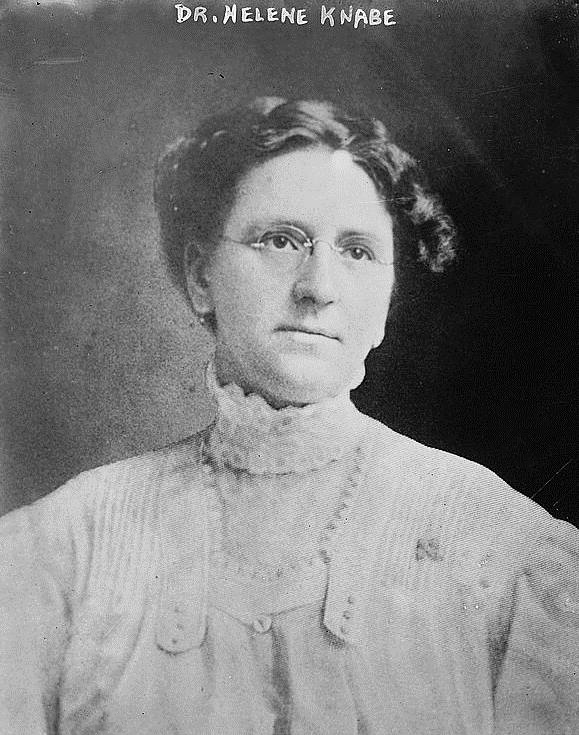
Helene Knabe, M.D. Dr. Helene Knabe in about 1908. Image by Bain News Service. U.S. Library of Congress, Prints and Photographs Division, Bain Collection. Source: U.S. Library of Congress, Prints and Photography Creator: Bains News Service Collection Date: 1908
Office-Home Site
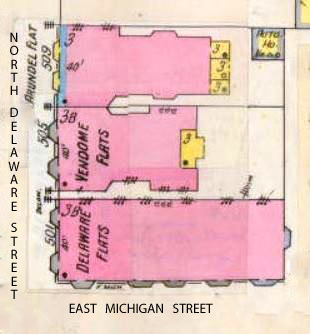
Office-Home Site Map showing the footprint of the Delaware Flats building in 1898; it was much the same when Dr. Knabe had her office-home there in 1911. Indianapolis Sanborn Map #176, 1898. Image courtesy of IUPUI Center for Digital Scholarship. Source: IUPUI Center for Digital Scholarship Creator: Sanborne Fire Insurance Maps Date: 1898
Medical Degree at the Indiana Medical College of Indiana, 1906
Medical Degree at the Indiana Medical College of Indiana, 1906 In 1904, Helene Knabe earned her M.D. degree from the Medical College of Indiana (MCI), which had been formed in 1878 by a merger of the Indiana Medical College and the College of Physicians and Surgeons. Initially located in a building at the northwest corner of Delaware and Court Streets in Indianapolis, MCI received a donation that financed construction of this building, which was completed in 1902. It was located on Senate Avenue opposite the Indiana Statehouse (the Indiana state capitol building). Image Courtesy of W.H. Bass Photo Company Collection, Indiana Historical Society. Source: W.H. Bass Photo Company Collection, Indiana Historical Society Creator: W.H. Bass Photo Company Date: 1906
Hygiene Laboratory, 1915
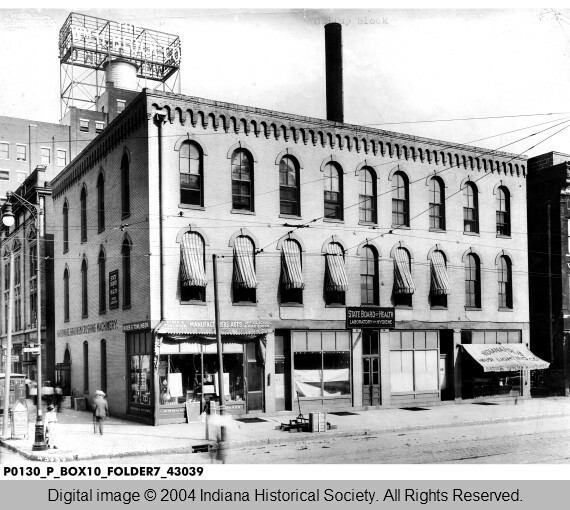
Hygiene Laboratory, 1915 From 1905 to 1908, Dr. Knabe was a bacteriologist for the State Board of Health's Laboratory of Hygiene, pictured here in about 1915. The building was located in Indianapolis at 45 North Capitol Street. Image Courtesy of W.H. Bass Photo Company Collection, Indiana Historical Society. Source: W.H. Bass Photo Company Collection, Indiana Historical Society Creator: W.H. Bass Photo Company Date: 1915
Leadership Role
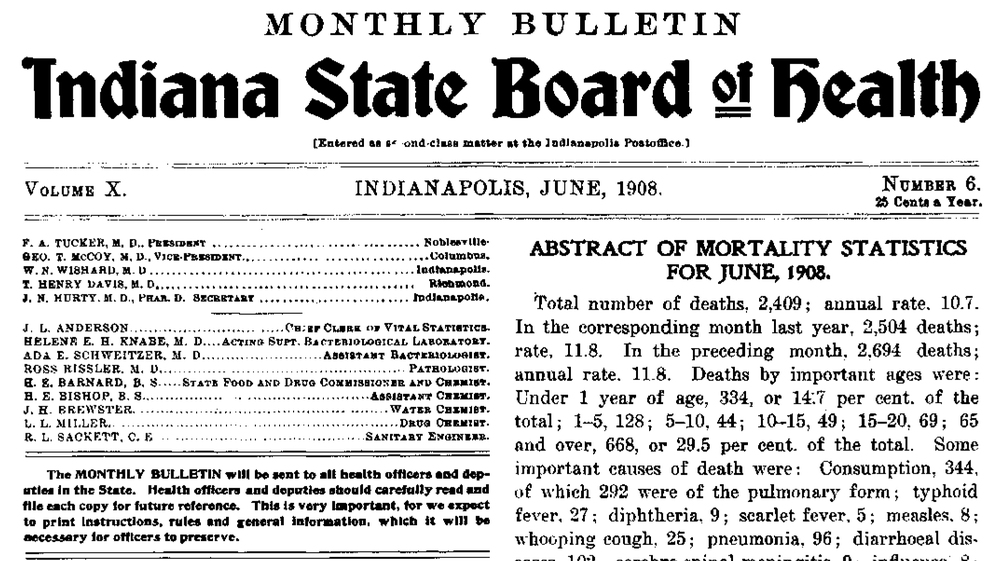
Leadership Role Among Dr. Knabe's positions was Acting Superintendent of the State Bacteriological Laboratory; she appears in this masthead. Source: Indiana State Board of Health, "Monthly Bulletin," June 1908. Image courtesy of IUPUI Center for Digital Scholarship. Source: IUPUI Center for Digital Scholarship Creator: Indiana State Board of Health Date: 1908
Resigns Position
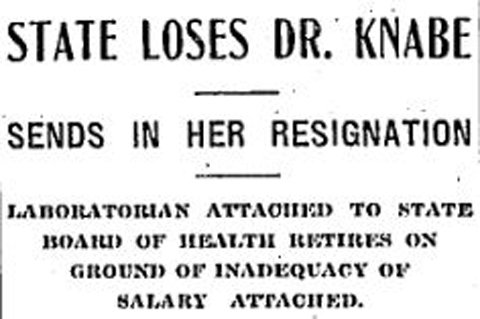
Resigns Position Dr. Knabe resigned from the State Board of Health over salary issues, declaring that she made this decision because the State Board of Health had promised to increase her salary from $1400 to $1800 per year, but had not done so. Image source: Indianapolis Star, 8 November 1908. Creator: Indianapolis Star Date: November 8, 1908
Private Practice
Private Practice Dr. Knabe's private practice was in her combination office-home in the Delaware Flats building. This 1911 city directory listing indicates that she was a physician whose address was apartment 2 at 503 North Delaware Street (the address of the Delaware Flats in 1911). The other listing is for her older cousin, Auguste Knabe, who had immigrated to Indianapolis a few years before Helene. The listing shows that she was a teacher at Public School Number 33 and a boarder at 1151 Bates Street. Helene Knabe also had boarded at that address before moving to the apartment in the Delaware Flats. R. L. Polk and Company's Indianapolis City Directory for 1911, Image courtesy of IUPUI Center of Digital Scholarship Source: R.L. Polk and Company's Indianapolis City Directory, IUPUI Center of Digital Scholarship Creator: R.L. Polk and Company's Indianapolis City Directory, 1911 Date: 1911
Murdered at Age 35
Murdered at Age 35 Headline from the initial newspaper report of Dr. Knabe's 1911 murder which, despite intensive investigation for more than two years, remains unsolved to this day. Image source: Indianapolis Star, 25 October 1911. Creator: Indianapolis Star Date: October 25, 1911.
Gravesite
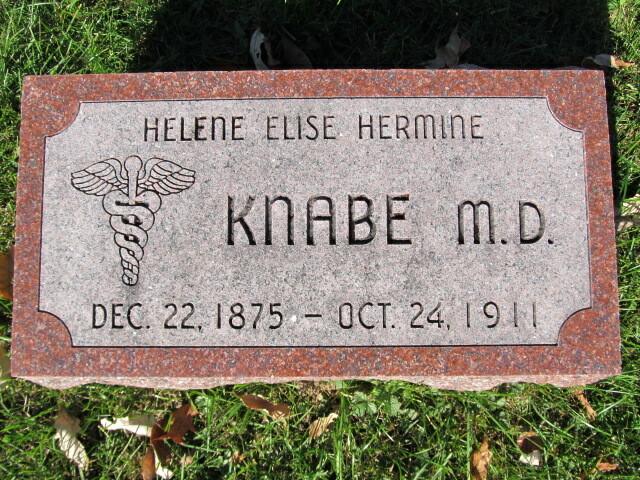
Gravesite Dr. Knabe was in financial distress at the time of her death; her grave in Crown Hill Cemetery (section 43, lot 6950) was unmarked until 2009, when caring citizens raised funds for a headstone and placed it on her grave. Crown Hill Cemetery (founded in 1877) is listed both on the Indiana Register of Historic Sites and Structures and on the National Register of Historic Places. Photo by Richard G. Dargatz, 2013. Creator: Richard G. Dargatz Date: 2013
Barton Hotel, 1933 2
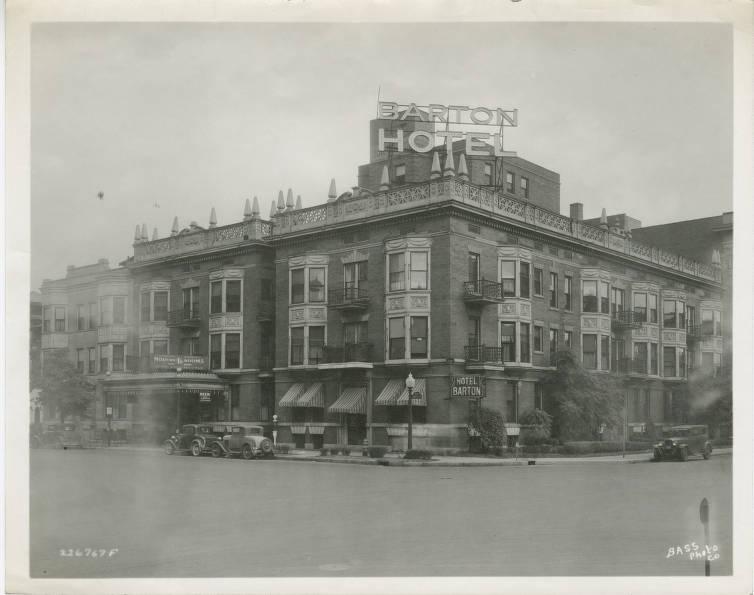
Barton Hotel, 1933 2 By around 1916, the Delaware Flats and the adjacent Vendrome building had been connected to one another. Together, they became the Barton Hotel, pictured here in 1933. The former Barton Hotel site is on the Indiana Register of Historic Sites and Structures. Source: W.H. Bass Photo Company Collection, Indiana Historical Society Image source Date: 1933

Location

Map

Metadata

Gail Gráinne Whitchurch, “Office of Helene Knabe, M.D.,” Discover Indiana, accessed October 22, 2026, https://discoverindianahistory.org/items/show/13.